
Preliminary screening
After a manuscript is submitted to “WSHIU Scientific Notebooks: Theory and Practice of Social Security”, the handling editor performs an initial screening to confirm alignment with the journal’s mission and scope, and to verify compliance with the submission requirements.
During preliminary screening the editor checks
- relevance to the journal’s thematic focus on social security and related disciplines
- completeness of files and metadata required for review
- basic methodological soundness and academic quality
- compliance with publication ethics, including originality and appropriate citation practice
Possible outcomes
- desk rejection, when the manuscript is outside the journal scope or does not meet the submission requirements
- return to authors for technical or formal revision, when the manuscript requires corrections before peer review
- transfer to peer review, when the manuscript meets the initial criteria
Editorial decision
- rejection with clearly stated reasons
- acceptance for publication
A manuscript may be rejected based on peer review outcomes. Authors are encouraged to use reviewer feedback to improve the work and address identified weaknesses.
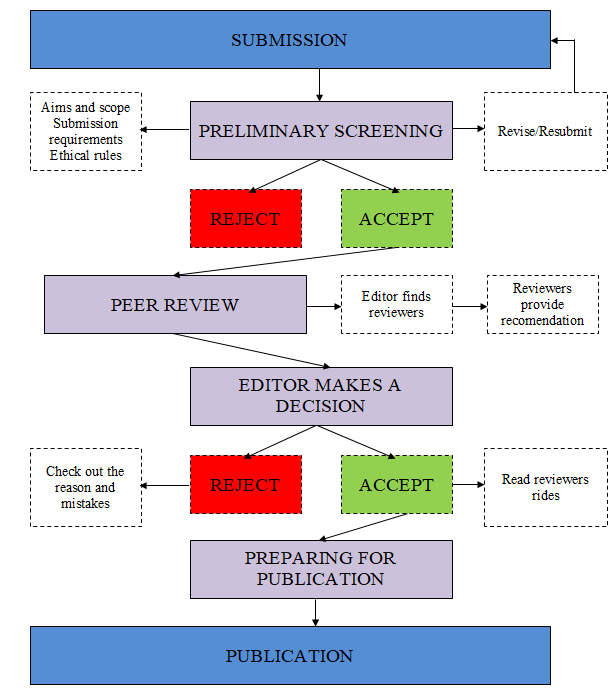
Workflow overview
Screening, Review, Revisions, Decision, Production
Key idea
Independent review, clear deadlines, transparent decisions
Revisions and resubmission
Authors are expected to address all reviewer comments and provide a structured response that explains how each point was handled.
! Standard deadlines
- up to 20 days for minor revisions
- up to 45 days for major revisions
The revision process may include more than one round, until the editor confirms that concerns have been resolved. When substantial changes are introduced, the manuscript may undergo an additional ethics and originality check.
Peer review
The journal uses a double anonymised peer review process. Authors do not know the reviewers’ identities, reviewers do not know the authors’ identities, and identities are visible only to the handling editor. Authors cannot nominate reviewers for their own submissions.
Each manuscript is evaluated by two independent reviewers. Reviewers are selected based on subject expertise, research experience, and independence. Reviewers may be drawn from the journal database, the Editorial Board, or external academic networks.
Typical timeline
Peer review duration depends on the manuscript topic and reviewer availability, and it typically takes up to two months.
Reviewer recommendations
- reject
- major revisions, revise and resubmit
- minor revisions
- accept without changes
Reviewer recommendations are shared with authors in an anonymised form. The handling editor evaluates all reports and makes the final decision. If reports substantially differ, or if the editor identifies potential bias or ethical concerns, the editor may appoint an additional reviewer.
After the manuscript has been accepted for publication, it enters the production stage. During this stage, the editorial team performs copyediting and language editing, checks the consistency of terminology, validates references and metadata, and formats the text according to the journal style. Next, the layout is prepared and a proof is generated and sent to the author for final review. The author is expected to carefully check the proof, indicate any minor corrections or technical issues, and return the approval or corrections within the deadline communicated by the Editorial Office. After this step is completed, the article is published online on the journal website.
Preparation for publication
- copyediting and language editing for clarity and consistency
- formatting according to journal style
- reference and metadata validation
- layout preparation and proof generation
- final author proof review within the deadline communicated by the Editorial Office
- online publication on the journal website
! Common reasons for rejection
- insufficient scientific contribution, or insufficient originality
- misalignment with the journal mission and scope
- non compliance with formal requirements or ethical standards
- plagiarism, redundant publication, or unreliable data
- citation manipulation or other unethical referencing practices
- failure to address reviewer and editor comments within revision rounds
- defamatory content, or emotional framing that may mislead readers
- disclosure of confidential or identifiable information without lawful basis or required consent
Tip:To avoid most problems, we highly recommend using only the TEMPLATE suggested by the editors.